


We like to say it began with 1-5-3—that strange, specific number of fish hauled ashore in the miraculous catch of John 21, the final chapter of the Fourth Gospel. But for readers diving into our new book on Mary Magdalene, Fishing on the Right Side of the Boat, the meaning of that number does not emerge until the very end of the book—in the last of its twelve chapters.
In the days before the book took its final form—after the design had been settled and the cover all but finished—we read the back-cover copy one last time before pushing to print and realized it was misleading.
“It begins with 153,” the copy declared. And for us, it had. But in that brief breath after round upon round of edits, we suddenly saw that this was not how the finished book unfolded for the reader. Their journey begins with a magical prologue set in Egypt, followed by an introduction that opens with a lost gospel written in Mary’s name—the Gospel of Mary, the only known gospel written in the name of a woman.
From there, they follow a winding trail of stories, symbols, and history toward Chapter Twelve: The Miraculous Catch, where the meaning of 153—and what it reveals about Mary—finally comes into view.
What followed was a flurry of stolen phone calls, text messages, and new drafts passed back and forth amid the messiness of our lives as we rewrote the entire back cover at the final hour. We needed it to reflect the journey the book had ultimately become, rather than the spark from which it first began for us.
This is where we landed:

Perhaps it was fitting that the final words came together amid the messiness of our lives, because the book itself had been gathering there long before we recognized it.
The clues never arrived in a neat and orderly progression, or even after we decided to write. They had been waiting in memory, place, family, and experience for us to recognize the pattern they had been forming all along.
*
A buttercup in a field at home, and another at the foot of Glastonbury Tor. A tattered tapestry we’d each seen on childhood field trips and the strange theory we uncovered when we returned to it decades later.
The name Catherine, woven through each of our families and through the lives of saints separated by centuries, until it seemed to point toward a Greek philosopher we had long admired—one whose story appeared, impossibly, to be entangled with Mary Magdalene’s own.
A five-pointed star. A cross. Symbols we had quietly carried for years before either of us imagined the pattern they formed.
Looking back, it is difficult to say where the research ended and our lives began.
A gap year in Italy gathering peaches in Campo de’ Fiori and wandering into a church whose significance would not become clear until decades later—one that quietly held within its walls a turning point in Mary Magdalene’s story. A family vacation that unexpectedly revealed a space dedicated to Mary in the most unlikely of places, filled with art that elevates her alongside Jesus.
Journeys taken separately. Journeys taken together. Places that at the time seemed ordinary, only to begin speaking to one another years later through a co-creative writing process we will not even attempt to explain.
Somewhere along the way, the boundary between the research and our own lives quietly disappeared. Friendship became collaboration. Paying attention became a way of following Mary—from the strangest source to the smallest footnote. We read everything we could find, following one citation into the next and searching the scholarship, symbols, stories, and silences for whatever might still be waiting there.
Meaning, we have come to understand, can emerge this way—not simply as pearls added one by one to a strand, but as something brought up from the depths.
You dive without knowing exactly what you will find. You search in dark water. You surface holding one small thing, then descend again: turquoise on the ceiling in an Egyptian temple, a woven squirrel, a Madonna hidden far beneath the later layers of an ancient church, discovered behind a wall that had been plastered over.
At first glance, she appears to be another familiar Marian icon. But she is a Byzantine empress, her neck adorned with five luminous pearls. Suddenly, those pearls seem to point beyond themselves—to Venus tracing her five-pointed path across the heavens, and to a pattern we had already begun to follow.
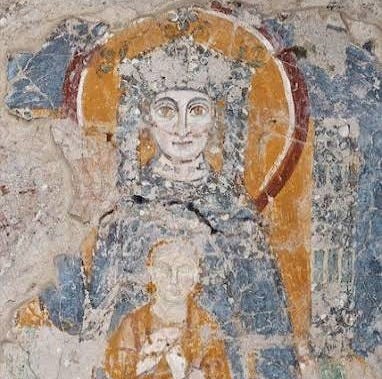
We had been diving for years, never knowing what the next descent might bring. Those years of gathering, and often struggling, gave us something we did not realize we would need: the courage to trust where Mary might lead us next, even when she carried us into places we never expected to go.
Which raises an unlikely question.
What, of all things, does Disney’s The Little Mermaid have to do with any of it?
Far more than we ever imagined. Beneath a story most of us think we already know lies another—one that leads through the depths, toward the ancient sirens, and back again to Mary Magdalene herself.
In Chapter One of Fishing, “La Grotte de Marie-Madeleine,” we describe the journey of searching for her as following “a woman, a saint, or a siren’s call that reverberates against Provençal limestone like thunder, lingering as a silent echo on the face of a mountain we must climb to find her.”
Perhaps that is what so much of this book became. Not an argument to be won, but a call to be followed. Not because every clue promised certainty, but because each one invited us a little farther into the depths. The work was never simply about collecting fragments. It was about trusting the strange pull that kept drawing them—and us—back into relationship.
*
On our quest for meaning, we encountered Clarissa Pinkola Estés’s La Loba, who gathers scattered bones and lays them tenderly beside one another. She sings until breath returns, flesh gathers around the bones, and what was lost rises whole again.
It’s an ancient story of reclamation, carried to us through a book first published in the 1990s. But what could it possibly have to do with Mary Magdalene?
And yet Women Who Run with the Wolves has long moved this way through women’s lives—shared in church basements, passed from one friend to another, and still discovered like a small piece of magic on bookstore shelves. We read it, carried it, cited it, and allowed its stories to shape the way we listened for the older stories beneath our own.
Its influence followed us beyond the boundaries of Christian history and into far older stories of creation, transformation, loss, and return. Those stories taught us to listen differently—to notice how one tradition can preserve an echo of another, and how a story told in a new name may still carry traces of what came before.
How did two authors bring a calling that had unfolded across both of their lives into a single book?
We kept following Mary until the work revealed its form: Fishing on the Right Side of the Boat.
*
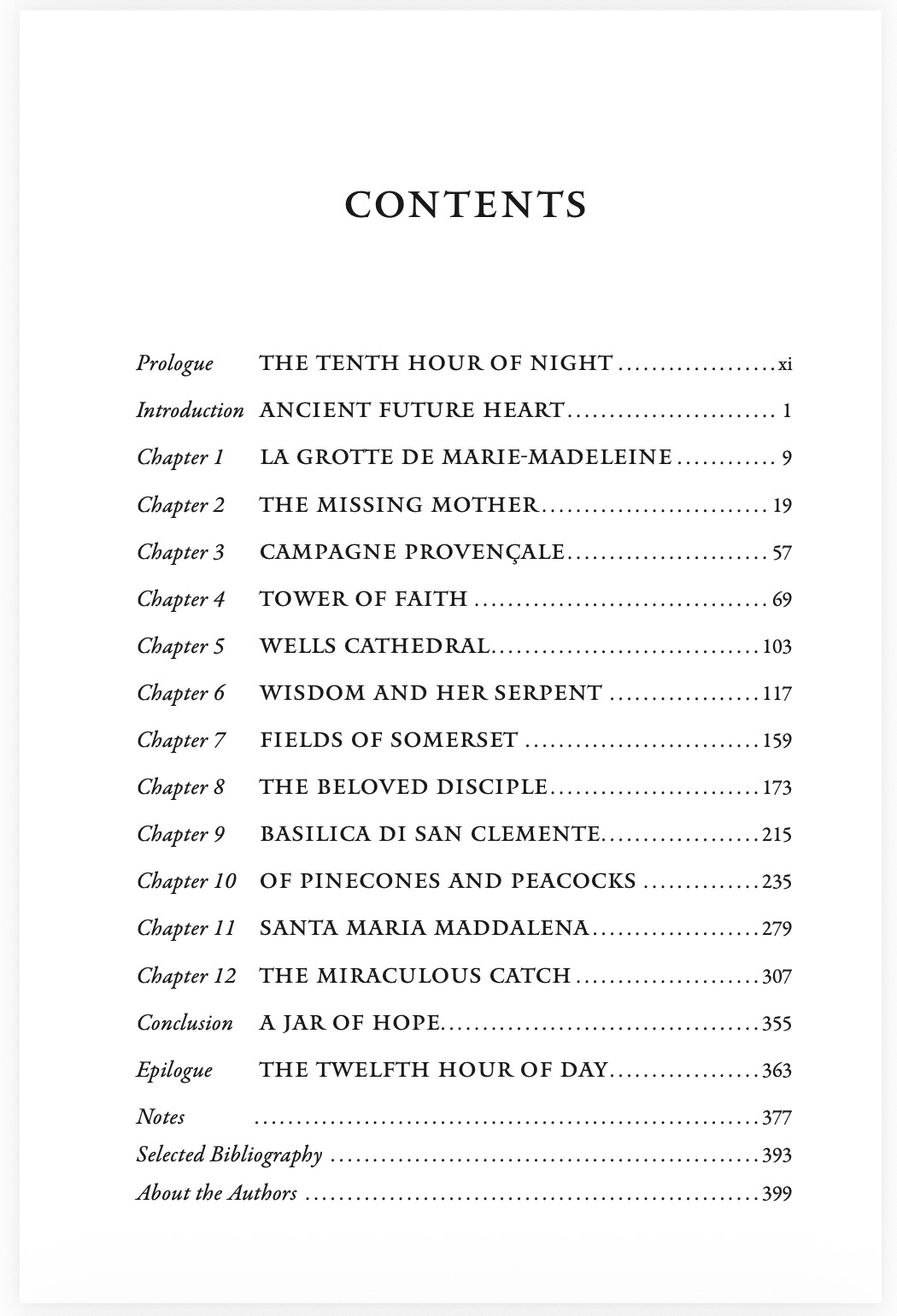
Within its pages, twelve chapters alternate between six pilgrimage stories and six historical deep dives.
Together they move from scripture and Christian history into far older creation stories, drawing the reader toward a vision of Mary unlike any we had encountered before. The journey culminates in the miraculous catch and a signature hidden within the Bible. Then comes the epilogue, a thirteenth movement standing just beyond the twelve, much like Mary herself as we came to understand her—not counted among the disciples, yet present where it matters most. It carries one final echo of the mystery surrounding the figure beside Jesus in Leonardo’s Last Supper and invites the reader to look again.
Only at the end could we see that the book had been teaching us how it wanted to be read all along.
That final rewrite was not simply about correcting a back cover. It was one last act of learning to follow the story rather than trying to lead it. Not by beginning with the answer, but by trusting the trail. One story opening into another. One unexpected turn asking us, once again, to pay attention. And then, almost without noticing, the scattered pieces began to gather around Mary.
So, along with the back-cover copy above, we wanted to share the path the book ultimately took. What follows is its table of contents—a glimpse of that trail, and an invitation to follow it with us.
For more on how we brought Fishing on the Right Side of the Boat to life, and future essays and conversations on Mary Magdalene and the sacred feminine, subscribe to The Magdalene Thread.
Having immediately purchased your book on Kindle, I want to share my deepest congratulations and excitement that you and Kelly have been able to synthesize all of the experiences and lessons you have learned not only throughout your life but particularly as you have sought Mary Magdalene. Having experienced a brief part of this journey with you, Alicia, I find my heart is open and so touched that you have been able to do this work and create this book for all of us. Thank you with all of my heart, and I greatly look forward to a deep dive into all that you have discovered together. It is such an honor to have been a part of your journey.
I am actually so excited to learn of your book through your email this morning and immediately wanted to say thank you and feeling blessed again to have just recently found you. I'm looking forward to the book and appreciate the depth of share for how it's come to be.