



Mary Magdalene is a woman who continually evades the nets of interpretation cast upon her, her memory shapeshifting according to what each age requires.
The questions we were asking, and the serpentine way we followed symbols, stories, evidence, and scripture, led us somewhere unexpected: to a possibility barely explored in either academic or mystical circles. That Mary Magdalene might be the Beloved Disciple, the eyewitness authority behind the Fourth Gospel.
To suggest that “John” was “Mary,” and to probe that final chapter in all its strange particulars, including the number 153, is no casual suggestion or provocative flourish. It is an argument shaped over years of inquiry, listening, and discernment, one that seems to carry our entire lives within it.
For all the qualitative elements behind our thesis, as women, daughters, and mothers, we listened closely to the clues: the sermon that didn’t land right, the book revealing a mandalic pattern within John, the next scholarly breakthrough in Mary’s name. One by one, they were found, gathered, and woven into a perspective on Magdalene’s identity we could never have dreamed up on our own, but that emerged through the accumulation of evidence, intuition, and attention.
And perhaps this is why 153 came to feel like more than a curious detail.
153 is the seventeenth triangular number, formed by stacking one row upon another, each containing one more than the last, until seventeen rows together total 153. Its logic is one of accumulation becoming structure: each piece resting upon what came before it, the whole taking shape only through the gathering.
To us, that pattern mirrors the hidden architecture beneath our book and the work we continue to share on Mary and the feminine. Scholars, sources, texts, images, questions, intuitions: each becomes part of the foundation beneath the next.
No, we are not scholars; we are “just moms,” nurturing nine children between the ages of one and seventeen within our unique families. We have educations and trainings, years of writing both publicly and into the void of unpublished drafts, and countless hours spent independently following threads across history, spirituality, science, literature, and art. None of it qualifies us as experts in the way expertise is most readily recognized.
We wrote without PhDs in theology or history. But we did not write alone. What we felt intuitively was so often met by another woman’s brilliant, rigorous research.
Again and again, our process began with an intuitive question, a feeling that something in the inherited story did not quite fit. Then a book would appear. A paper. A translation. A scholar who had spent years studying the very question we had only just learned how to ask.
The ideas in our book did not emerge from revelation untouched by evidence, nor do we claim them as knowledge available uniquely to us. They were built in conversation with women who had already searched, studied, translated, questioned, recovered, and spoken what they found. Their work gave language to intuitions, challenged our assumptions, corrected us, and sometimes opened an entirely new path.
We are profoundly indebted to them.
Perhaps because Mary has so often greeted us in the most ordinary places, amid diapers, driving, missed appointments, unfinished dishes, and all the mix-ups of motherhood we have learned to blame on writing about the Magdalene, we cannot imagine standing above anyone else in this work.
We would rather walk slowly and bow deeply to those who came before us, those searching alongside us now, and those who will surely come after.
We have no desire to become gatekeepers of information. Quite the opposite.
We want to place what we have found into the hands of other women seeking Mary: women who may already feel that they know her, yet are still searching for a language, an identity, a model, or some dimension of her that has not yet been fully expressed.
Whenever possible, we chose to cite women who had already done the searching before us. Scholars who returned to manuscripts, reconsidered old assumptions, recovered forgotten figures, questioned inherited readings, and made their work available for others to build upon.
There are, of course, many other ways Mary reaches people. Through novels, memoir, art, pilgrimage, devotion, mystical experience, and storytelling. Our book is not a channeled text or a memoir, and so here we want to honor the women whose scholarship most directly shaped our own work.
Only after the manuscript was complete did we stop to count the women whose work we had referenced.
There were eighty-five.
Eight and five become thirteen. And 5, 8, and 13 are consecutive numbers in the Fibonacci sequence, a mathematical pattern that appears again and again in the growth forms of the natural world: in spiraling seed heads, pinecones, petals, and the arrangement of leaves around a stem.
Five, eight, and thirteen are written into one of the celestial patterns that runs throughout our book: the movement of Venus.
Over roughly eight Earth years, Venus completes nearly thirteen orbits around the sun. During that same span, she passes between Earth and the sun five times. Plot those five encounters against the zodiac, and they trace a remarkable fivefold pattern, often rendered as a pentagram or the five-petalled rose of Venus.
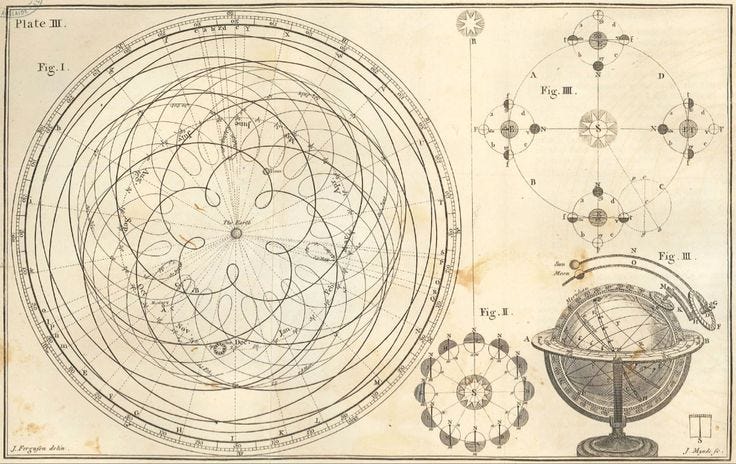
This pattern was known long before anyone could map the orbit from above. Ancient peoples tracked Venus as she disappeared and returned, evening star becoming morning star. In Mesopotamia she was associated with Inanna and later Ishtar, whose symbols included the rosette; across cultures that brilliant wandering star would also become linked with Astarte, Aphrodite, and Venus.
Since the beginning of our friendship, numbers have been a shared language between us, another form of symbol that seems to speak. Like a word, an image, or any other symbol, a number can become a clue, asking us to stop, look again, and wonder.
And so five, eight, and thirteen were familiar to us, much like 153 had before them: 1 + 5 + 3 becoming nine, a number of completion, while 3 + 5 becomes eight. It was 153, the number of fish gathered in the final chapter of the Fourth Gospel, that we had followed for years.
We were not the first women drawn to Magdalene to find ourselves counting. More than thirty years ago, Margaret Starbird added the Greek letters of ἡ Μαγδαληνή and arrived at that same number: 153.
Her name appears here alongside Elizabeth Schrader Polczer, Joan Taylor, Sandra Schneiders, and many others whose methods and conclusions do not always align. Some shaped arguments central to our thesis. Others offered a symbol, a textual clue, a work of art, a name, or simply a way of seeing we had not encountered before.
These women did not give us one answer. They gave us many points of light. And in learning to see the pattern they formed, Mary became more visible to us.
The Thirteen
Even before we counted all eighty-five, thirteen names had already separated themselves: thirteen women whose work sits closest to the center of our argument.
And still, we are indebted to every name that follows. Some shaped who we believe Mary Magdalene may have been. Others stand behind a single idea, a single endnote, one sentence we could not have written without them.
So we offer their names with enormous gratitude, and with the hope that you will follow them beyond the pages of our book.
Not as a conclusion, but as an invitation: eighty-five doors left open for whoever feels called to walk through them next…
1. Elizabeth Schrader Polczer. In 2017, Polczer published an article in the Harvard Theological Review, one based on her master’s thesis, that shook the world of biblical textual scholarship. Originally a professional singer-songwriter, Polczer was following a calling towards studying Mary Magdalene within the earliest manuscripts of the Gospel of John when she entered her academic training. While reviewing Papyrus 66, she discovered a discrepancy that had been overlooked, a scribal edit that erased Mary of Bethany and multiplied her into Mary and Martha. This astonishing discovery, alongside her work on the meaning of “Magdalene,” the Gospel of Mary, and fragment P.Oxy. 5577, has continually amazed and inspired us in our writing.
We first discovered Polczer through Diana Butler Bass’s lecture that went viral here on Substack. Bass has continued to interview Polczer as her research unfolds, and you can watch her initial sermon here:

2. Sandra M. Schneiders. As one of the most respected Johannine scholars in the field, Schneiders’ work first appeared to us when we were seeking to understand the Gospel of John, and its women, Magdalene included. At the very end of her masterwork, Written That You May Believe, is Part III: “A Feminist Reexamination of the Authorship of the Fourth Gospel,” containing a single chapter, “Because of the Woman’s Testimony …” In it, Schneiders brilliantly probes the possibility that Mary Magdalene could be the Beloved Disciple. Her perspective was integral to the thesis we put forth in Fishing on the Right Side of the Boat. She is the most-cited living scholar in our Beloved Disciple chapter.
3. Elaine Pagels. Pagels is, for us, the godmother of early Christian history. The Gnostic Gospels won the National Book Award and did what a specialist monograph almost never does: it took the Nag Hammadi library out of the seminar room and handed it to the rest of us. She is who we lean on for female authority inside the Valentinian and Marcionite communities, and for the story of how the Nag Hammadi codices came to be buried at all, in the shadow of Athanasius’s Festal Letter of 367 and the canon it was closing. Her Adam, Eve, and the Serpent stands behind our pages on Augustine, on desire and embodiment and the making of original sin, which is to say behind everything the tradition afterward did with Eve.
4. Ally Kateusz. After reading Kateusz, we never looked at women in Christian art the same way again. Her careful survey of early images and texts in Mary and Early Christian Women: Hidden Leadership shaped the way we learned to follow patterns and symbols of feminine authority. Her earlier book, Finding Holy Spirit Mother, inspired us too, as we explored similar questions about the feminine language and imagery once used for the divine.
5. Joan E. Taylor. A professor at King’s College London, Joan Taylor coauthored the 2021 Journal of Biblical Literature article on the meaning of “Magdalene” with Elizabeth Schrader Polczer. Together, they gathered the literary evidence for reading “Magdalene” not simply as a place name, but as a title, illuminating Mary as a “Tower of Faith,” the title of our fourth chapter. Taylor’s earlier work, Jewish Women Philosophers of First-Century Alexandria, too opened a pivotal door for us, expanding what we thought possible for Mary and allowing us to ask whether she, too, might have been a philosopher.
6. Lizzie Berne DeGear. In “(m)Adam: Adam’s Rib Reframed,” DeGear returns to a word we thought we already understood: “rib.” The Hebrew word ṣēlāʿ, the word we all learned as “rib,” is used almost everywhere else in scripture to describe architecture: the side of a building, the chamber of a temple. The questions DeGear raises about translation, language, and the feminine completely changed the way we approached words throughout our book, teaching us to slow down, weigh them, and ask what else they might once have meant.
7. Barbara E. Reid. Dominican Sister and biblical scholar Barbara Reid brought a perspective to Luke that felt especially powerful to us: a woman reading scripture from within the Christian tradition, while still asking hard questions of the text. In Choosing the Better Part?, she looks beyond the familiar praise that Luke includes more women than any other Gospel and asks what those women are actually permitted to say and do. Reid taught us that the presence of women in a text is not the same thing as giving them authority or voice.
8. Paula Fredriksen. Fredriksen is one of the scholars who most changed the way we understood the first centuries of Christianity. Her Ancient Christianities: The First Five Hundred Years gave us a window into those early centuries, when identities and communities were still forming, long before institutions took official shape and settled on a single narrative. She gave us the context to see how deeply these religious worlds overlapped, and how women held active roles across Christian, Jewish, and Roman religious life, widening our understanding of who Mary Magdalene herself might have been as a historical woman.
9. Kathleen Gallagher Elkins. It is hard to express how deeply Elkins’s work on the mother-martyr pattern affected us. In Mary, Mother of Martyrs, she gives form to something we had long sensed without knowing how to name: the idea that a mother proves her holiness through the surrender of her child was not simply inherited from antiquity. It was constructed in the first centuries of Christianity, by people with reasons for constructing it, and Elkins asks us to look closely at who benefited from that ideal.
10. Ann Graham Brock. After reading Brock’s Mary Magdalene, The First Apostle: The Struggle for Authority, we will never see the primacy of Peter in Christianity the same way again. Her brilliant comparison of the Gospel traditions showed us how Peter’s authority was gradually elevated while Mary Magdalene’s was diminished, a pattern that continued through Christian history. Her analysis of the Gospel of Luke in particular became central to the way we came to understand what happened to Magdalene’s memory, and what that changing memory might reveal about who she had once been.
11. Karen L. King. Few scholars have been more important to the modern recovery of Mary Magdalene’s authority than Karen King. For us, she is the voice of the Gospel of Mary, the scholar who helped bring this extraordinary text out of the margins and into serious conversation about early Christianity.As the first woman to serve as Harvard’s Hollis Professor of Divinity, King herself embodies the shift in perspective that has allowed women’s authority, both within Christianity and its history, to be seen anew.
12. Elisabeth Schüssler Fiorenza. In Memory of Her is one of the foundational texts of feminist biblical scholarship. Without Fiorenza’s work, it would be difficult to imagine seeing Mary Magdalene the way we do now. She helped create the framework for asking who had been left out of the story, whose authority had been minimized, and what becomes visible when women are placed back into the center of early Christian history. Her work gave scholars after her permission to ask different questions, and gave us permission to do the same.
13. Margaret Starbird. Starbird holds a very special place not only on this list, but in our book and in our hearts. Like us, she was a mother working outside academia. And perhaps it was partly that position as an outsider that allowed her to notice what others had passed over and ask questions others were not yet asking: whether “Magdalene” might be a title, what the number 153 might mean, how gematria and isopsephy could matter, and what the recurring symbols surrounding Mary in art might be trying to say. We do not agree with every conclusion Starbird reaches, just as we do not agree with every conclusion of every woman on this list. But without the example of someone willing to follow a question beyond the accepted boundaries of scholarship, we might never have believed we could do the same.
Mary Magdalene
14. Jane Schaberg. The Resurrection of Mary Magdalene: Legends, Apocrypha, and the Christian Testament (Continuum, 2002).
15. Susan Haskins. Mary Magdalen: Myth and Metaphor (Harcourt Brace, 1993).
16. Cynthia Bourgeault. The Meaning of Mary Magdalene: Discovering the Woman at the Heart of Christianity (Shambhala, 2010).
17. Katherine Ludwig Jansen. The Making of the Magdalen: Preaching and Popular Devotion in the Later Middle Ages (Princeton, 2000).
18. Meggan Watterson. Mary Magdalene Revealed: The First Apostle, Her Feminist Gospel & the Christianity We Haven’t Tried Yet (Hay House, 2019).
19. Esther A. de Boer. The Gospel of Mary: Beyond a Gnostic and a Biblical Mary Magdalene.
20. Sarah Parkhouse. Eschatology and the Saviour: The Gospel of Mary among Early Christian Dialogue Gospels (Cambridge, 2019).
Scripture and the early church
21. Adela Yarbro Collins. The Apocalypse (Michael Glazier, 1979), and with John J. Collins, King and Messiah as Son of God (Eerdmans, 2008).
22. April D. DeConick. Voices of the Mystics (Sheffield Academic Press, 2001) and Holy Misogyny (Continuum, 2011).
23. Bernadette J. Brooten. Women Leaders in the Ancient Synagogue: Inscriptional Evidence and Background Issues (Scholars Press, 1982).
24. Claudia Setzer. “Excellent Women: Female Witness to the Resurrection,” Journal of Biblical Literature 116, no. 2 (1997).
25. Diana Butler Bass. “Elizabeth Schrader on Preaching John 11,” The Cottage (March 20, 2023).
26. Elizabeth A. Clark. Women in the Early Church, Message of the Fathers of the Church 13 (Michael Glazier, 1983).
27. Kari Elisabeth Børresen. Subordination and Equivalence: The Nature and Role of Woman in Augustine and Thomas Aquinas (University Press of America, 1981).
28. Pheme Perkins. The Gnostic Dialogue: The Early Church and the Crisis of Gnosticism (Paulist Press, 1980).
29. Carole Straw. Gregory the Great: Perfection in Imperfection (California, 1988).
30. Susan Ackerman. Under Every Green Tree: Popular Religion in Sixth-Century Judah (Scholars Press, 1992).
31. Judith M. Hadley. “The Khirbet el-Qôm Inscription,” Vetus Testamentum 37, no. 1 (1987).
32. Nina E. Livesey. The Letters of Paul in their Roman Literary Context: Reassessing Apostolic Authorship (Cambridge, 2024).
33. Phyllis Trible. God and the Rhetoric of Sexuality (Fortress, 1978).
34. Ross Shepard Kraemer. When Aseneth Met Joseph (Oxford, 1998).
35. Susan Ashbrook Harvey. “Feminine Imagery for the Divine: The Holy Spirit, the Odes of Solomon, and Early Syriac Tradition,” St. Vladimir’s Theological Quarterly 37, no. 2 (1993), and Scenting Salvation (California, 2006).
36. Susan Wessel. Cyril of Alexandria and the Nestorian Controversy (Oxford, 2004).
37. Tal Ilan. Lexicon of Jewish Names in Late Antiquity, Part I: Palestine 330 BCE–200 CE (Mohr Siebeck, 2002).
38. Tikva Frymer-Kensky. Reading the Women of the Bible (Schocken, 2002) and In the Wake of the Goddesses (Free Press, 1992).
39. Sandra L. Zimdars-Swartz. Encountering Mary: From La Salette to Medjugorje (Princeton, 1991).
40. Angie Heo. “The Virgin Made Visible,” Comparative Studies in Society and History 54, no. 2 (2012), and The Political Lives of Saints (California, 2018).
41. Pearl Zaki. Our Lord’s Mother Visits Egypt in 1968 & 1969 (Dar el Alam el Arabi, 1977).
Egypt & ancient Near East
42. Alison Roberts. Hathor Rising: The Power of the Goddess in Ancient Egypt (Inner Traditions, 1997).
43. Barbara S. Lesko. The Great Goddesses of Egypt (Oklahoma, 1999), and editor, Women’s Earliest Records from Ancient Egypt and Western Asia (Scholars Press, 1989).
44. Betty De Shong Meador. Inanna, Lady of Largest Heart: Poems of the Sumerian High Priestess Enheduanna (Texas, 2000).
45. Christiane Zivie-Coche. “Imentet,” in The Oxford Encyclopedia of Ancient Egypt, vol. 2 (Oxford, 2001).
46. Diane Wolkstein. With Samuel Noah Kramer, Inanna, Queen of Heaven and Earth (Harper & Row, 1983).
47. Geraldine Pinch. Egyptian Mythology (Oxford, 2002) and Magic in Ancient Egypt (Texas, 1994).
48. Lise Manniche. Sacred Luxuries: Fragrance, Aromatherapy, and Cosmetics in Ancient Egypt (Cornell, 1999).
49. Margaret A. Murray. The Osireion at Abydos (Bernard Quaritch, 1904).
50. Orly Goldwasser. “How the Alphabet Was Born from Hieroglyphs,” Biblical Archaeology Review 36, no. 2 (2010).
51. Sylvie Cauville. Dendara: Les chapelles osiriennes, 3 vols. (IFAO, 1997–1998).
52. Vera Frederika Vanderlip. The Four Greek Hymns of Isidorus and the Cult of Isis, American Studies in Papyrology 12 (Hakkert, 1972).
53. Sally-Ann Ashton. Cleopatra and Egypt (Blackwell, 2008).
The classical world
54. Anna Maria Carruba. La Lupa Capitolina: un bronzo medievale (De Luca Editori d’Arte, 2006).
55. Joan Breton Connelly. Portrait of a Priestess: Women and Ritual in Ancient Greece (Princeton, 2007).
56. Lynn R. LiDonnici. The Epigraphical Evidence of the Festival of the Artemis Ephesia (Scholars Press, 1992).
57. Madeleine M. Henry. Prisoner of History: Aspasia of Miletus and Her Biographical Tradition (Oxford, 1995).
58. Maria Dzielska. Hypatia of Alexandria, trans. F. Lyra (Harvard, 1995).
59. Mary Beard. “The Sexual Status of Vestal Virgins,” Journal of Roman Studies 70 (1980), and with John North and Simon Price, Religions of Rome (Cambridge, 1998).
60. Nanno Marinatos. Minoan Religion: Ritual, Image, and Symbol (South Carolina, 1993).
61. Raffaella Cribiore. With Roger S. Bagnall, Women’s Letters from Ancient Egypt, 300 BC–AD 800 (Michigan, 2006).
62. Sarah B. Pomeroy. Women in Hellenistic Egypt: From Alexander to Cleopatra (Schocken, 1984).
63. Sarolta A. Takács. Isis and Sarapis in the Roman World (Brill, 1995).
64. Sharon Kelly Heyob. The Cult of Isis Among Women in the Greco-Roman World (Brill, 1975).
65. Stacy Schiff. Cleopatra: A Life (Little, Brown, 2010).
66. Stephanie Lynn Budin. The Myth of Sacred Prostitution in Antiquity (Cambridge, 2008).
67. Lynn E. Roller. In Search of God the Mother: The Cult of Anatolian Cybele (California, 1999).
68. Emma J. Edelstein. With Ludwig Edelstein, Asclepius: A Collection and Interpretation of the Testimonies, 2 vols. (Johns Hopkins, 1945).
Medieval and mystics
69. Janina Ramirez. Femina: A New History of the Middle Ages, Through the Women Written Out of It (Hanover Square Press, 2022).
70. Dyan Elliott. The Bride of Christ Goes to Hell: Metaphor and Embodiment in the Lives of Pious Women, 200–1500 (Pennsylvania, 2012).
71. Larissa Juliet Taylor. The Virgin Warrior: The Life and Death of Joan of Arc (Yale, 2009).
72. Régine Pernoud. With Marie-Véronique Clin, Joan of Arc: Her Story (St. Martin’s Press, 1998).
73. Marie-Véronique Clin. With Régine Pernoud, Joan of Arc: Her Story (St. Martin’s Press, 1998).
74. Julia Fox. With John Guy, Hunting the Falcon: Henry VIII, Anne Boleyn, and the Marriage That Shook Europe (HarperCollins, 2023).
75. Patricia F. Cholakian. With Rouben C. Cholakian, Marguerite de Navarre: Mother of the Renaissance (Columbia, 2006).
Art, architecture, and sacred places
76. Joan E. Barclay Lloyd. “The Building History of the Medieval Church of S. Clemente in Rome,” Journal of the Society of Architectural Historians 45, no. 3 (1986).
77. Luisa Mortari. S. Maria Maddalena (Istituto Nazionale di Studi Romani, 1987).
78. Elsa Van Der Zee. Wells Cathedral: An Architectural & Historical Guide, 2nd ed. (Close Publications, 2017).
79. Danielle Oteri. “The Secret of the Unicorn Tapestries,” The Paris Review (November 18, 2020).
Ancient memory
80. Marija Gimbutas. The Language of the Goddess (Harper & Row, 1989) and The Living Goddesses (California, 1999).
81. Merlin Stone. When God Was a Woman (Harcourt Brace Jovanovich, 1976).
82. Clarissa Pinkola Estés. Women Who Run with the Wolves (Ballantine, 1992).
83. Marie-Louise von Franz. Alchemy: An Introduction to the Symbolism and the Psychology (Inner City Books, 1980).
84. Barbara Ehrenreich. With Deirdre English, Witches, Midwives, and Nurses: A History of Women Healers, 2nd ed. (Feminist Press, 2010).
85. Deirdre English. With Barbara Ehrenreich, Witches, Midwives, and Nurses: A History of Women Healers, 2nd ed. (Feminist Press, 2010).
What a rich and beautiful gift of expansive love you have poured out here. I found some authors on the list that I have not yet read. I will dig in!!
Heading to France next month for a pilgrimage with the Magdalene and this post just added fuel to the fire 🔥
I love the honoring and braiding of women’s scholarship. As someone who did a master’s in religion, which included a year of Greek and a year of Hebrew, I LOVE seeing women engage with these spaces with their intuition and brains fully alight.