


When we first began drafting the book that would become Fishing on the Right Side of the Boat, it started with a letter. Perhaps it was a declaration of intention, or a way of naming why we felt called to write about Mary Magdalene, the most misunderstood and controversial woman at the heart of Christian history.
It opened with the words, We believe in Love… a belief that shaped everything that followed.
We did not set out to challenge the Bible or overturn the tradition that formed us, but to look closely at both: to search for Mary, attend to what had been left out, and ask difficult questions from within that inheritance, through our eyes as women and mothers.
For more than a year of writing and rewriting, that letter was the one thing that remained constant. Our outline shape-shifted, chapter titles evolved, and countless sentences were word-smithed until the paragraphs worked (or were deleted when they didn’t). Through it all, we were writing a book called The Magdalene Thread, the title this Substack publication still carries. Or so we thought.
With only two chapters left to write, we believed the shape of the book was finally settled and that our finish line was near. And then, everything changed.
*
On the eve of the first of two blizzards in 2026, our research led us to a realization we could no longer ignore.
If we were right about the meaning we had found in the 153 fish of the miraculous catch, the editorial fingerprints within the Gospel of John, and the way those clues reshaped our understanding of Mary Magdalene and the Beloved Disciple, then the implications were enormous.
Read alongside the long history of women’s suppression within Christianity, they pointed toward a startling possibility about whose eyewitness memory ultimately lay behind the Gospel itself, and revealed that Mary Magdalene’s role was far greater than we had imagined when we first began writing.
The evidence forced us to weigh our conclusions against the centuries of interpretation behind them. And amidst that process, it was impossible not to feel the familiar judgments reserved for ideas that threaten what has long been accepted: blasphemy, ridiculous, foolishness, hypocrisy, crazy, heretical.
But we continued to follow Mary beyond the boundaries of the story we thought we were telling. And the farther she led us, the more we realized that the questions before us were no longer only about Christianity. They were about women, about memory, about whose stories endure, and whose voices disappear. While as writers we had always deeply believed that stories carry power, we had come face to face with how history shapes the way we understand ourselves, one another, and even God.
The more the story expanded, the more we found ourselves returning to the intention with which we had begun: Love.
Not as an idea, but as something we knew in our bones as mothers. Between the two of us, we’ve brought nine children into the world.
We know what it is to discover, with each child, that love does not divide; it expands, somehow there is always more. Every pregnancy has taught us the same impossible lesson: a heart already convinced it was full could somehow make room for more. With each child new fears arrive alongside new doubts, sleepless nights, but also a joy, strength, and wellspring of resilience we could never have imagined before. Once you have lived that kind of expansion in your own body, you begin to trust that making room for more does not diminish what came before. On the contrary, it deepens it.
Mary’s story was asking the same thing of us. Our book had become larger than the title we had given it, more expansive than the manuscript we had written, spiraling beyond anything we could have imagined.
If we were going to honor the Magdalene in the fullness of who we had come to understand her to be, and follow the questions her story opened about women, memory, and the feminine within Christianity and beyond, we had to allow the book to become something larger too.
*
Letting go is never easy, but we knew surrendering the title, the draft, and even the letter that had remained our anchor from the very beginning was the next right step. But almost as soon as we loosened our grip, a new title surfaced or, perhaps more fittingly, was pulled from the depths.
It arrived with such clarity and conviction that it left us awestruck, because it was not simply a new name for the book, but a phrase drawn directly from John 21, the miraculous catch, and the 153 fish that had led us to everything the book had become: Fishing on the Right Side of the Boat.
Looking back, we can see that this stage of the creative process was much like the seventeenth mile of the New York City Marathon. Anyone who has run it knows the stretch where runners hit their “wall” after moving through boroughs filled with cheering fans. Maybe it’s the incline, or even the silence, but it’s when the race gets real as you settle into a very long and quiet uphill trek across the Queensboro Bridge.
This is when the crowds disappear, the music stops, and for a while it is just you, the resistance, and the voice in your head wondering if you can keep going. It’s about when you realize you have come too far to turn back, but also know the hardest miles have yet to be run.
“Shake out your arms!” fellow runners will yell, feeling the spirit of the group wavering, knowing that group cohesion—even among strangers in a race—lifts the whole.
It was our seventeenth writing mile when we realized we needed to let go of the book we thought we were finishing so we could make room for the fuller story Mary had led us to tell.
It was during the second blizzard that we broke out onto First Avenue, lined with cheering fans—a brief surge of energy as it became clear that the book we had pieced back together was even better than our original version.
And then, you might say, we found ourselves in Central Park navigating those last daunting miles toward the finish line. As a bomb cyclone storm buried the world outside once more, the exhilaration of discovery gave way to the task of rewriting the entire manuscript.
“Wintering” we called it, thinking about all that lies beneath the surface before it rises again like the first daffodils of spring. We shoveled paths to the cars (and even cleared way for the dryer vents) while weaving new sentences with the same mix of blind faith and determination: word by word…shovel by shovel…day by day.
*
Neither of us is a professional runner, but we both run. Often, we run to untangle a stubborn paragraph, to pass time waiting for the right synonym to drop in, or simply to reconnect with our bodies after spending so much time in our heads. Through those winter miles, we found ourselves returning often to the words of our favorite Peloton coach, Becs Gentry: “Forward is a pace.”
One step. One page. One sentence. One day at a time. And then, almost without realizing it, the daffodils were beginning to bloom just as the manuscript that had once seemed impossible settled into its form.
By spring, the book we had laid down in winter had returned to us transformed. In following Mary, we had not left the beginning behind. We had arrived there again with different eyes. As the book moved out of our hands and into the world, we found ourselves looking back at the journey—at where it had begun, and at the letter we had surrendered to the mountain of drafts and research left behind. When we returned to it, we saw that it still held something our readers had never been given: a glimpse of who we were at the beginning, what we believed, and the love from which this work first grew.
So we dug it out of what we now lovingly call our “Fishing Graveyard” to share here, just with our Substack readers.
If this book taught us to trust anything, it's that nothing offered in love is truly lost. It may change form, or sink beneath the surface for a season, but it doesn't disappear.
We hope it offers you a glimpse of who we were when we started, our shared intentions as mothers and creators, and the love that carried us farther than fear ever could. And if you read Fishing on the Right Side of the Boat, we hope it also offers a small window into how both the book and its authors evolved along the way.
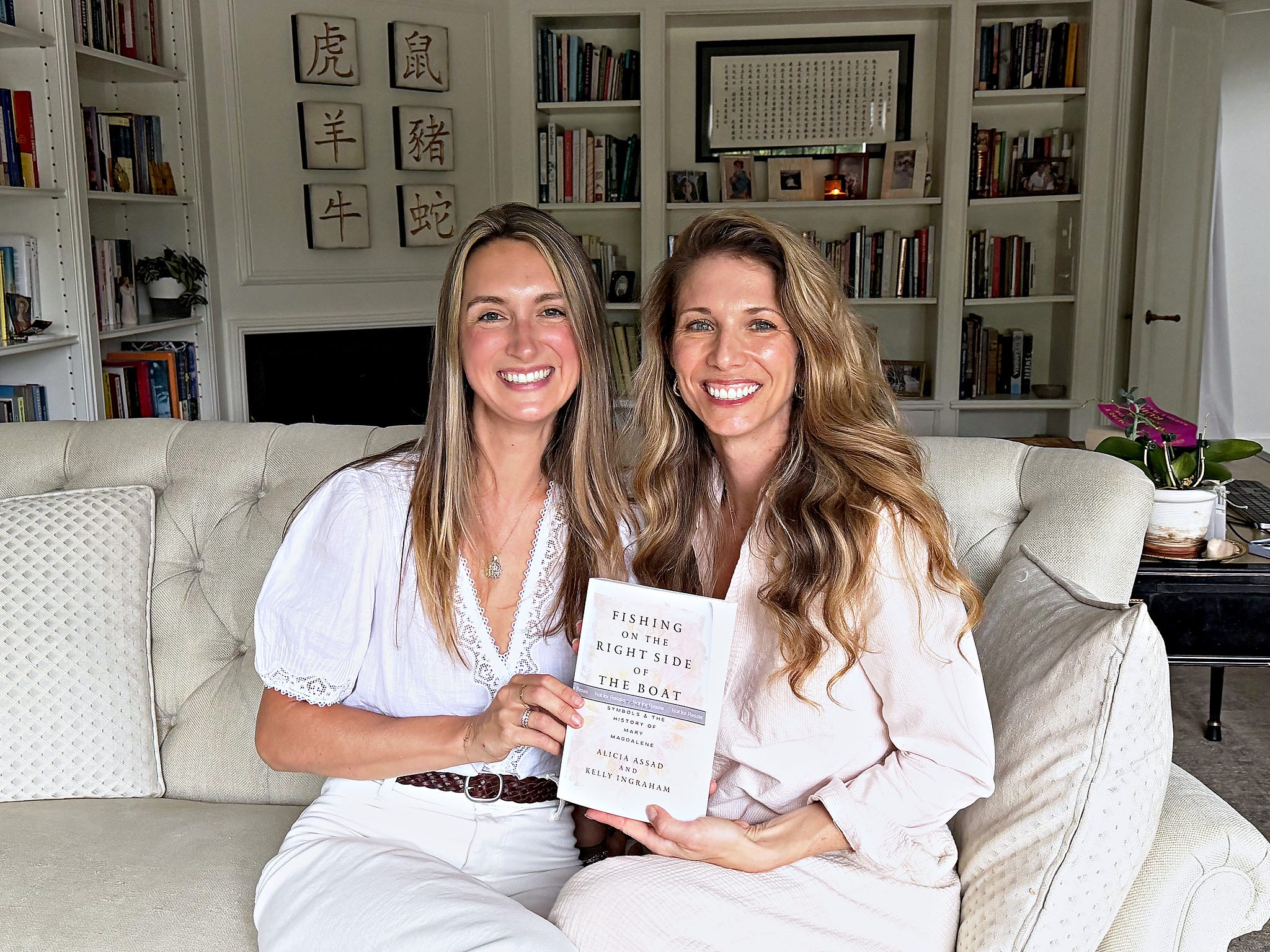
They say a marathon changes you, just as bringing a child into the world transforms your identity and experience of life. Even tending a garden can offer the same creative metamorphoses, though we will happily admit both of ours have suffered while we were busy writing this book. Perhaps that may be why the image feels so fitting now: a garden teaches us that what disappears from view is not necessarily gone, and that what has been tended in one season may not reveal itself until another.
We have never thought about the seventeenth mile in the same way since. It still amazes us that, somewhere around the seventeenth mile of our own journey, the quiet significance of 153, the seventeenth triangular number, was revealing itself within the very story we were writing.
Now, as we place this letter into your hands, we see it differently than we did when we first wrote it. We no longer see an opening that didn’t make the book.
We see the seed from which the book first grew.
A Letter from the Authors
We believe in Love.
As two mothers and cradle Christians who have found ourselves oscillating between pews, yoga mats, and every other space of healing you can imagine in pursuit of faith, we have wandered far and wide. If two roads diverge in a yellow wood, then we collide in friendship and collaboration on a matter that has led us, together, down a way less traveled. Daily, our meandering pilgrimage continues with every step trod and word written, into the unknowns that surround an elusive figure named Mary Magdalene.
While we’ve each lived our own stories of awakening, what unites us is realizing that what we longed for wasn’t out there on the horizon, waiting under the neon lights of success with a box to check. As the story of our partnership goes, we met in the trenches of modern motherhood where there is no clear way to define success and a million ways to fail. Camaraderie makes it easier to walk a path of authenticity, though the unrealistic ideals of feminine grace are as real as they are pervasive in a reality defined by sharp edges and a linear trajectory. A shift in perspective reveals a million reasons to gain resilience and grow, but we must breathe into the levity of hope with the full expansion and contraction of our lungs. If only the truth about our unique goodness despite our messy human experiences were written in stone. Yet there is no manual to guide a heart cracked open with maternal love, destined to unfurl beyond a duality in which darkness remains separate from all that is light.
No, motherhood is not necessary to inspire a quest to understand the unanswerable. Simply, it is the domain in which the veils lifted for us, and where we recognized an imbalance and deep need for healing and restoration. The spiritual experience of unconditional love and nurturing is less considered by our culture—along with all that is undefinable and stretches beyond the reach of our arms in the universal process of creativity. Both adversity and a desire for wisdom are initiators of growth and expansion, and curiosity was survival before it revealed the blank space of the feminine in its divine form, which was missing from the religious paradigm we were raised in. So, we leaned into this void, intent on understanding the absences that exist around the ideas we’ve been sold as “truth” by exploring philosophies, practices, and possibilities to foster meaning and amplify goodness. We were not looking for Mary Magdalene when she found us, nor will we be the last to insist that the simple intention to know who she was swept us up in a wave of ethereal wonder. Regardless, she appeared with enough potency to fill in the gaps that are half an equation of wholeness. It seems that in all her mystery and complexity, the Magdalene illuminates what is as dark and regenerative as the womb in its role as the cradle of all humanity.
Faith expressed in spans of forty days can be found across cultures from fasting practices to the desert temptation, and even the forty days the planet Venus seems to move in reverse across the sky. It can also be argued that the original “forty” arises from the length of a woman’s pregnancy, for the weeks we count from the first day of a last menstrual cycle to birth will engender the miracle of creation. Yes, at one point in ancient societies, the feminine stood at the center of spirituality precisely because of “her” role in life, death, and rebirth. However, with the rise of monotheism and patristic hierarchical systems across both church and state, the goddess fell from grace, and in that process, women were maligned and persecuted, especially those who stood in roles of power and authority. Since then, the feminine has long been absent from our collective image of divinity, and that which rules the right side of the brain, including intuition, has been devalued as our culture became increasingly focused on all that is external, tangible, and scientific. This is a loss we felt our way into, but even left-brain logic suggests the adage “as above, so below” falls woefully short of reflecting the full truth because without both female and male, there is no creativity, in the most literal sense of the word.
We are not the first or the last to ask questions around the malaise of modern motherhood or the diminishment of Mary Magdalene and feminine spirituality. While choosing to reintegrate what was lost and reimagine the stories we’ve been told, we don’t claim to have the “the” way or even all the answers. Instead, what we point to is the art of surrender, as practiced in our role as “just moms” whereby we have worked at prying our white-knuckle grips from beliefs and ideas and even from our children. In pursuit of a deeper understanding of Love, with a capital L, we followed Mary beyond the boundary lines of orthodoxy, and “letting go” has not been without general discomfort and primitive fears. Indeed, our ancient wiring once insisted death lies on the other side of the boundary lines that have been drawn for us, but we have lived to tell the tale of blindly soldiering on through the fires of transformation, trusting that we would somehow be reborn from the ashes of what we allowed to burn.
We now rise with winged immortality, or rather the courage to resurrect the wisdom of Love through Mary Magdalene, who becomes a template for wholeness, offering a renewed sense of possibilities for our faith. As her presence emerges from layers of tradition, exploring Mary brings into view a tangled web of beliefs and ideas that shape our modern reality. Whether through her example or scripture, “the one called Magdalene” offers a gateway of expansion that turns the tide towards a narrative of inherent goodness. To fathom her as a teacher, philosopher, and embodiment of peace is no small feat in a paradigm intent on diminishing her. Let it be said that what is symbolically evil for some is, for others, a positive representation of change and renewal. And as we expand old ways of being and seeing, much must be released. In the way a snake sheds its skin, all that seems to break down becomes, in truth, the fertilizer of regeneration. Ultimately, as new life springs forth green from the dark, nothing is ever lost. Mary, then, is a seed of potential, offering the hope that our faith might rise, heal, grow, and flourish from within.
Just as we must work at fighting despair, we must learn to allow the experience of joy, because Love is eternally what negotiates the paradox of creation wherein we are both fully human and divine.
Furthermore, what we love can move with us, even if it takes on new forms and meaning as we recreate our own kingdoms of “heaven on earth.”
“For in the winds of all adversity stands the calm Dove of Peace,
and in the serenity of heart, we remember:
Fear is an illusion; there is only Love.”
Alicia & Kelly
For more on how we brought Fishing on the Right Side of the Boat to life, and future essays and conversations on Mary Magdalene and the sacred feminine, subscribe to The Magdalene Thread.